

Get anytime access to our growing collection of classes and workshops.
-
-
How your camera works - but also making the camera work for you.
What to look for in a camera (stop getting caught in the weeds).
Setting up the camera to give you the truest colours you can get.
Polarizers aren’t always the answer!! Don’t “just use a polarizer” and “lighting your painting then putting a polarizing filter on your light”.
The negatives of using a polarizer.
Slightly technical talk about your cameras and lenses “sweet spot”
What ISO, F-stop and shutter speed do to your image.
Best way to light your image From a low cost budget (free natural) to higher budget set up. (Explaining the angle of incidence).
NEGATIVE FILL (many won’t know what this is, but this is what helps with the glare issue!!)
Checking the image after in whatever software you use! You do not need photoshop! I just use photos on my Mac. By this point the adjustments needed won’t be huge. The idea of this image is for it to look as natural as it does just sat on your easel.
-
You don’t have to have these things for the livestream. These are just a good guide so you can see what you may need.
Cameras
Canon 4000D - approximately £160 - 18 megapixels, is a good low budget option.
Link here to the body only - It’s only 169 for the body. If you are just going for the body option (no lens package) do yourself a massive DO NOT get the lens that comes with it. It’s effectively like taking a photo through a jam jar. Get this and your images will be much sharper and brighter. Approx £180
Panasonic GH5 - this is a camera I have used for years and taken both photographs and filmed on. Very good camera 20.3 megapixels you can easily buy these used for around the £500 mark.
Link to a used site here for the body - a good lens is this one for the Panasonic 50mm.
Sony A7R 3 - Recently been using this for some images and is insanely sharp offering double the megapixels of the GH5 at 42.2 is a higher end budget of £1,189 Link here
Nikon 850 - high end option at around £1700 body only. A huge 45.7 mega pixels. Used a lot in wildlife photography massive images! And good for low light situations too. If you’re going big on the camera get this.
If you can avoid it, please do not buy a zoom lens. They aren’t that good unless you spend big money on them and by that I mean double to the price of the high end camera above. Try to used fixed (prime) lenses. They let in more light and are much sharper.
Lenses
Samyang 50mm f1.4 - a bit more expensive (fits on more cameras) Manual focus!
Polariser - URTH polariser (check your lens, on the front of the lens there will be an 0 with a line through it and a number after it like 77. Thats how big your polariser needs to be. eg 77mm
Lights
The cheapest option is free!!! It’s called Natural light. Take your painting into a naturally lit room or even outside on an overcast day, we will be covering this on the day.
A great low budget option by a company called Amaran. The smaller cheaper option offered by Aputure (Amaran is their sister company). Incredibly versatile, I will be explaining why these lights are great as an option they are around £297 - great bang for you buck they are so bright. We use these in the studio to light models.
Reflector / flag kit for negative fill
Godox light matts - amazon doesn’t sell them
-
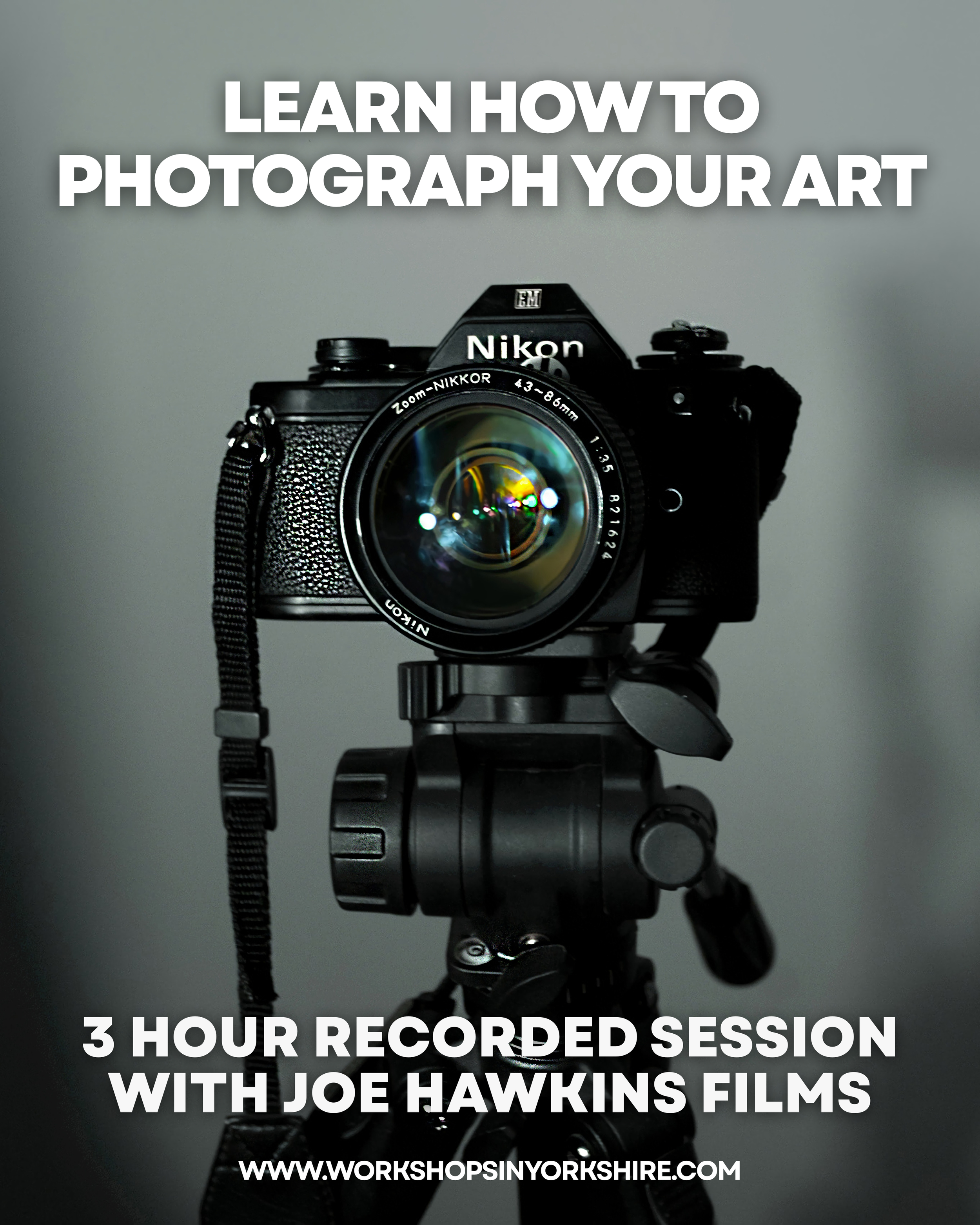
The workshop is focused on using a dedicated camera rather than a smartphone. Joe will explain why phones aren’t ideal for photographing artwork and will share his recommended camera options, which are also listed in the description. While some concepts may still help those who use a smartphone, the instruction and demonstrations will be centred on camera-based art photography.
-
We will have this online for 1 year due to newer technologies always coming out.